Tuesday, July 20, 2010

Ode to the Taco: Recommendations For Further San Diego Research


Glancing briefly at the wad of junk mail daily stuffed inside our mailbox, my attention was grabbed by a flashy, glossy color insert courtesy of the folks at Jack In The Box, who are currently hawking both a revamped "late night" drive thru menu and their venture into the realm of Mexican food. And if you didn't think Mexican food could get more half-assed than Taco Bell's Volcano Taco, think again. Or should I say, look closer at the image I've helpfully pasted above. What caught my eye was the fact that Jack In The Box features a crunchy shell taco (we're already far from the realm of la auténtica comida mexicana, but wait for it) featuring a single slice of American Processed Cheese almost thoughtfully tucked into the side of each taco shell. It looks absurd in the officially-sanctioned corporate advertising photo, and I can't imagine how foul it looks in real life. I picture it drooping, in a quickly-congealing lump of yellow-orange, across the brittle taco shell, breaking apart in one chunk with the first tentative bite.

Never mind the fact that cheese plays a very small role in authentic tacos. Never mind the fact that when cheese does make a rare appearance, it is typically in the form of the very mild and crumbled queso blanco. I'll even be willing to admit that American-style tacos, from Southern California to the Texas border, are often smothered in cheese and taste none the worse for it. But even the barbarians have the common decency to shred the stuff before handing the taco over.

Looking at such horrors, I remind myself that much of the country remains stranded in what I've dubbed the Malo Corridor of Mexican Food, a zone buffeted on the one hand by junkfood chains like Taco Bell, Taco John's or Del Taco and on the other by grinningly genteel "casual dining" Mexican-American restaurants with all-English menus, deep-fried burritos, enormous taco salads and Super Nachos. It's largely what I grew up with passing for Mexican food, with two greasy crunchy tacos and a pintos 'n cheese from Taco Bell after soccer practice fixing my jones, or a family visit to Chi Chi's in Appleton in the pre-Hepatitis A days, or any number of countless and now-forgotten interchangeable variations on cheese-drenched platters with mild side-optional salsas.

And yet, the taco revolution continues to spread, north and east. Those of us ensconced safely within the borders of Southern California may feel smug when it comes to authentic border food, but as the country's Hispanic population expands and shifts, better food follows. I was first struck by this a few summers ago visiting my wife's family in Walla Walla, Washington. Hardly a bastion of Hispanic culture, the region nevertheless has seen a large influx of Latino families, especially during the harvest season when the valley sags under the weight of wheat and sweet onions. A surprising addition to Walla Walla has been the presence of several competing and rather excellent taco trucks setting up residences in various locations, such as El Taco Loco, parked in front of the Melody Muffler and offering an authentic menu like lengua tacos for cheap. Similar stories are being told in regions of the rural Midwest, long forced to subside on Mexican Pizzas and bland jars of Pace Picante Sauce and now boasting solid offerings of tacos sudados or tacos al pastor (and perhaps even glasses of horchata). The reasons for this steady influx of new immigrants aren't necessarily positive ones - far too often, the work bringing new immigrants is dangerous, non-unionized and exhausting, thus dominated by recent arrivals lacking a solid education. But if any positives are to be found among the many crimes committed by Nebraska pig farms or Kansas livestock operations, the cultivation of self-sustaining Hispanic communities among formerly lily-white farming towns may be one.

There's more to the story than taco trucks, of course. Chefs like Rick Bayless have been drawing attention to the possibilities of combining authentic Mexican fare with gourmet techniques for years, and his 1987 book Authentic Mexican: Regional Cooking from the Heart of Mexico is a landmark text. Yet I can't help but feel that we're at yet another tipping point in culinary history when more Americans than ever before are sampling real or nearly-real approximations of Mexican cuisine, from five-course dinners to 75 cent street tacos. While there remains an almost overwhelming dependence upon processed taco junk, it's also never been easier to sample a cabeza taco.

San Diego's taco scene is less well-defined than our big brother to the north, where a vital taco truck following and a much larger Hispanic population has combined to create a nearly unprecedented American variation on street food culture. We San Diegans still rely on local chains like Roberto's (dubbed "Regretto's" by those in the know unlucky enough to have spent an evening or two with upset stomachs after devouring a greasy burrito) and many even partake of national chains. But the real taco lovers among us traverse the city to locate new roach coaches, grimy walk-up taco stands and refined variations on traditional recipes. Although far from complete, the following list offers a handful of must-try taco destinations in our fair city.

TABE taco trucks traverse the greater San Diego region, offering Chef Todd Ichinaga's Korean-Mexican fusion to mobile eaters, including bbq chicken tacos dredged in Teriyaki and Maui salsa, Bass ale battered fish tacos, and vegan offerings for those interested. The salsa bar alone at Mama Testa Taqueria in Hillcrest is worth a visit, and while tourists flock to sample the fish tacos that famously beat Bobby Flay's on a recent Food Network program, I recommend the Mama Cesta or "steamed tacos" - especially the mashed potato-filled en papas. The Linkery's menu changes daily, but one can usually find a scrumptious taco filled with a housemade sausage link with navy beans, while their recent "Tijuego" gastro-cantina spin-off, El Take It Easy, dives further into the tradition, with grilled pork belly tacos and rabbit taquitos alongside three variations on micheladas. Brave the grime and grit outside La Posta de Acapulco's Taco Shop on Third Avenue in Hillcrest and you'll be rewarded with one of the richest carne asada tacos in town. My wife swears by the rolled tacos smothered in gaucamole and shredded cheese at Ocean Beach's Nico's, and while the nonstop ID-checking and sports bar atmosphere of nearby South Beach Bar & Grille is obnoxious, for once they're not lying when they talk up the quality of their seafood tacos, from mahi mahi and wahoo to shark and lobster. 30th and Adams' Cantina Mayahuel whips together tasty $4.50 tacos, with my favorite being the lime-marinated sirloin taco filled with shredded cabbage-carrot-cilantro, washed down with one (or two) of their 145 tequilas. Also strong on the tequila front is the decidedly upscale El Vitral on J Street, with a mushroom, white corn, poblano and cheese taco starter especially memorable. Touristy and far too busy for me, the taquitos at India Street's El Indio are nevertheless a San Diego institution, with Ralph Pesqueira Jr. presiding over the sixty-year old home of the original rolled taco. Any number of astonishingly awesome taco stops could be made in the Barrio Logan neighborhood, but I'll give a nod to Las Cuatro Milpas (heavenly carnitas tacos with truly hot hot sauce) and the freshly-fried fish tacos at Rivas on Logan Avenue. While they also serve up tacos for carnivores, the real draw at Ranchos Cocina (OB and North Park locations) are the veg/vegan-friendly offerings, such as tofu or nopales tacos. And for some real street-food fun, track down the good folks running the MIHO Gastrotruck, with an ever-changing menu that doesn't always feature tacos (their veggie poutine is, thankfully, a constant) but has served up in the past Yucatan-inspired cochinita pibil tacos filled with spicy pickled red onion (and don't forget to ask for the Mexican coca cola, one glass bottle of cane sugar and absolutely no high-fructose corn syrup goodness).

I guarantee none of these places will insult you by tucking a slice of processed cheese into anything you order.

Monday, July 12, 2010

How We've Spent Our July Thus Far, or; King Harvest Has Totally Come


We may be running a small operation over here in University Heights, but that doesn't mean ordinary activities and leisure sports don't get put on hold when the fruit ripens ominously on the trees or the herbs and greens spread wide across the garden patch. And as a week of unseasonably cool and damp weather gives way to early morning sunshine and long dry afternoons, it's quickly becoming apparent that we'll need to stagger our attack to keep up with the backyard harvest. If last June, Jane and I put in a large order for pickling cucumbers and spent one long afternoon making a mega-batch, this year we're forced to respond to the natural rhythms of our garden, in which maybe two to three jars worth of pickling cukes are being produced each week, not the twenty jars of last year. And as the plums continue to ripen and clunk to earth, we're quickly learning to divvy up those consigned to snacking and those relegated to further preservation. Needless to say, we're getting lots of use from our canning and drying equipment.


Our Weeping Santa Rosa plum tree has proven a remarkable provider - the attractive little green branches and leaves have been ornamented with beautiful dark-purple fruit globes for weeks now. We know they're ready when they fall heavily to the grass below, and I've learned to check every few hours and scoop up the fruit before less desirables discover them (birds, squirrels, neighborhood kids). With far more available than we'd be capable of eating in one sitting, and fruit fries becoming ever more bold (note - a tall glass with a tiny splash of beer or a rotting piece of fruit in the bottom, and plastic wrap rubber-banded across the top of the glass studded with a few tiny holes, will take care of the little bastards), I decided to look into some kind of canning recipe more involved than simply dumping sliced plums and sugar onto the stove top.


What I luckily found was Pam Corbin's simple recipe for spiced brandy plums, calling merely for honey, orange zest, 7 tablespoons of brandy, cinnamon sticks and anise pods. I pulled out my bottle of Macieira Royal Brandy, tasted it to make sure it passed the quality test, and allowed Jane to set about creating a brandy syrup with the honey, some water, the zest and the brandy. The plums were sliced in half, packed inside our canning jars, and the cinnamon sticks and star anise crammed down alongside the fruit.


We then poured the hot brandy syrup up to the rim of the jars. And what a wonderful aroma of hot fruit, brandy, cinnamon and orange filled the kitchen!


All the while, I was busy setting about prepping my end of the bargain - pickling cucumbers from the garden. We would only have enough for two jars this time around, but the amount of effort needed to organize the vinegar, mustard seeds, dill, garlic and hot peppers was still notable.


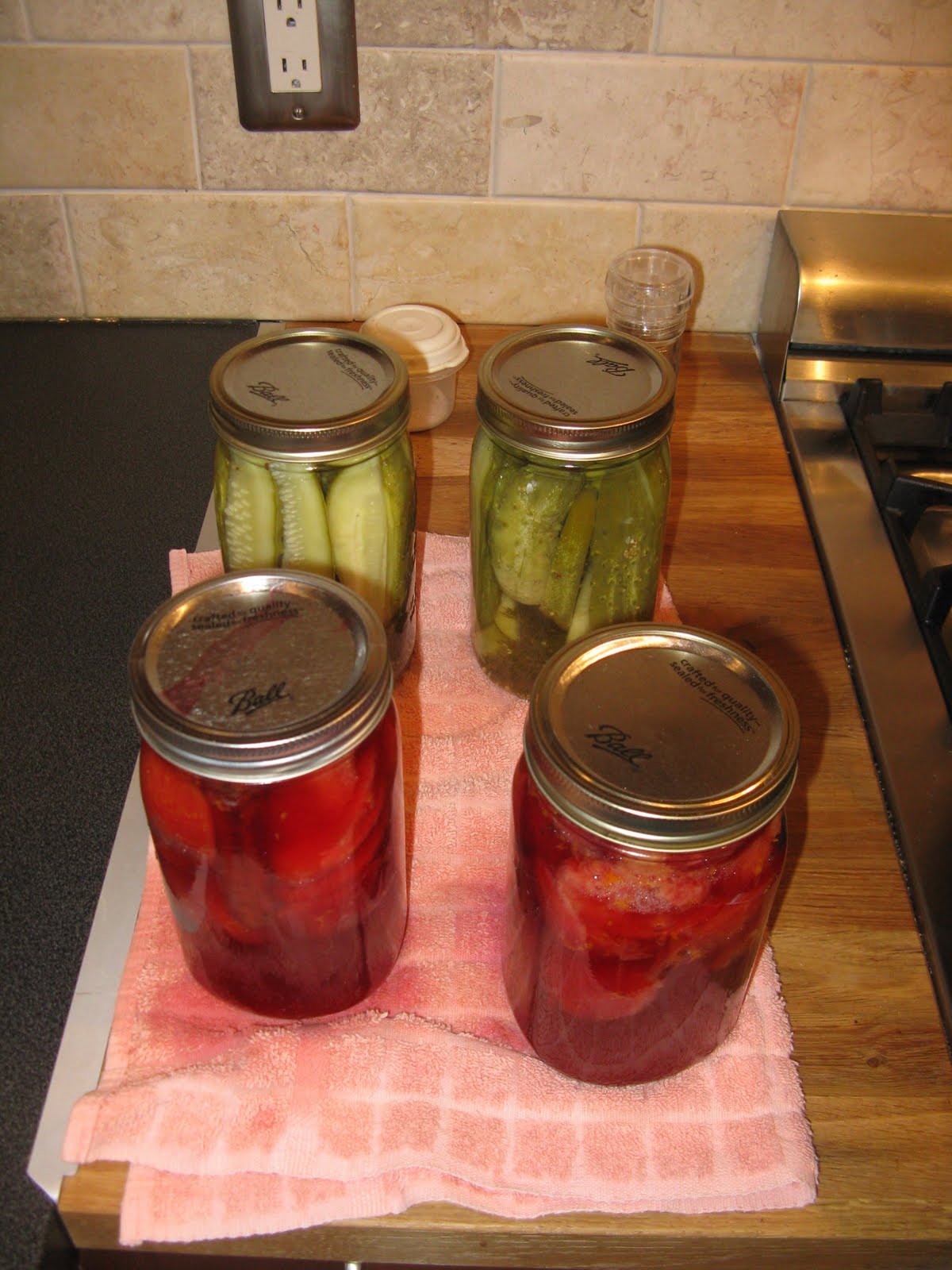
However, the big difference this time was our ability to seal an entire batch in one go, with the plums nestled alongside the cucumbers, and with the fruit removed slightly before the pickles. We also discovered that our totally awesome stove did the job of boiling a huge amount of water in much less time than before, meaning our job was quicker and less exhaustively warm (and that the pickles look much crisper and light-green). Within fifteen minutes, two jars of soon-to-be-pickles and soon-to-be spiced brandy plums sat on the kitchen counter.


................................................................................................................................................................


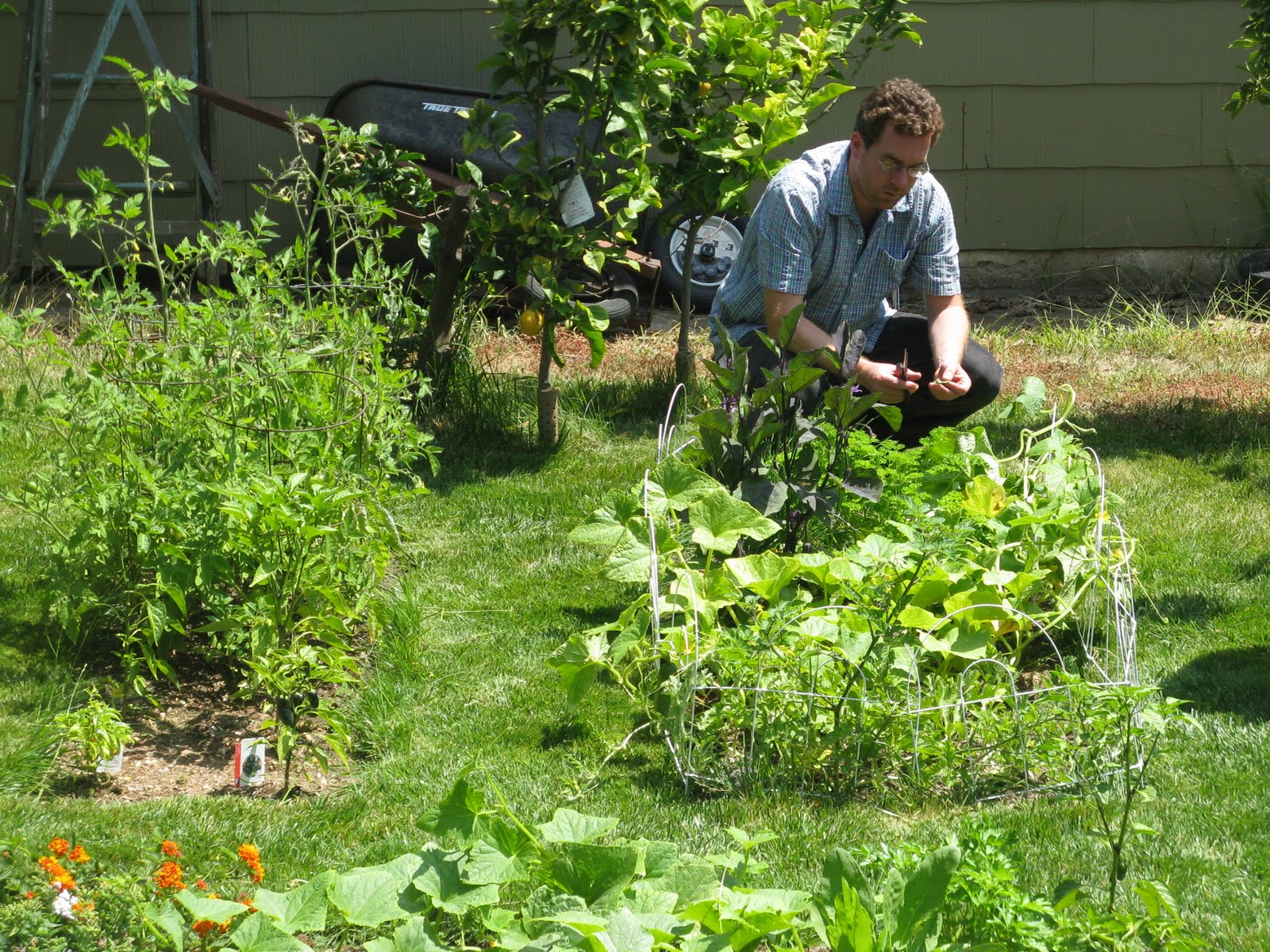
But within the week, our garden had announced plans of its own. Our small patch of oregano had spread wide and fast, while two distinct clumps of parsley, both curly and flat-leaf, were announcing their presence. Time to pick and time to dry.


We had enough herbs picked to fill four trays on the food dehydrator, even though the garden itself looked like we'd barely made a dent. Drying oregano and parsley was a bit time consuming, partly due to the rather low temperature required (95 degrees). We set up the equipment in the late afternoon and let it hum away all night, until around noon the following day, when we decided it was approaching an acceptable level of bone-dryness.


But in the meantime, there was more to be done. Another weekend, another crop of pickling cucumbers daring to overtake the garden. As the herbs dried away, we supplemented the garden pickles with a few cukes from our CSA. May I express a little bit of green-thumb pride in the fact that our pickling cukes were far superior to the supplementary ones? The image below shows the CSA pickles on top, ours along the bottom.


However, we were lucky enough to meet up with head honcho Farmer Joe (it's what he calls himself) at our JR Organics CSA stand, where he periodically stops by to chat up the Hillcrest Farmer's Market shoppers, which very often include local chefs and restaurateurs. Hearing that Jane planned on pickling today, he tossed in for free a tall stalk of fresh flowered dill, and recommended adding the flowers to the very top of our jars. They were lovely, and we gladly accepted this free gift. The benefits of knowing the man who grows your food!


But as I set about once again dicing the cukes and peeling the garlic, Jane set about yet another concurrent project. We had a large amount of rhubarb left over from a 4th of July pie she had made and brought to Twentynine Palms, and a glance through our preserving cookbooks turned up a recipe for Sweet Pickled Damson Plums, easily modified to incorporate rhubarb. A little cider vinegar, a cinnamon stick, allspice berries and orange zest were brought to a boil, while sugar and chunks of rhubarb were added and softened. The rhubarb was placed inside the jars....


....and the hot spiced vinegar was poured over the top. We boiled both the four jars of pickles and the three smaller jars of sweet pickled rhubarb for fifteen minutes, and then removed them and waited for the seal.


The herbs at this point were also ready, so I removed them from the dehydrator and placed them into individual plastic baggies, ready for cooking use.....


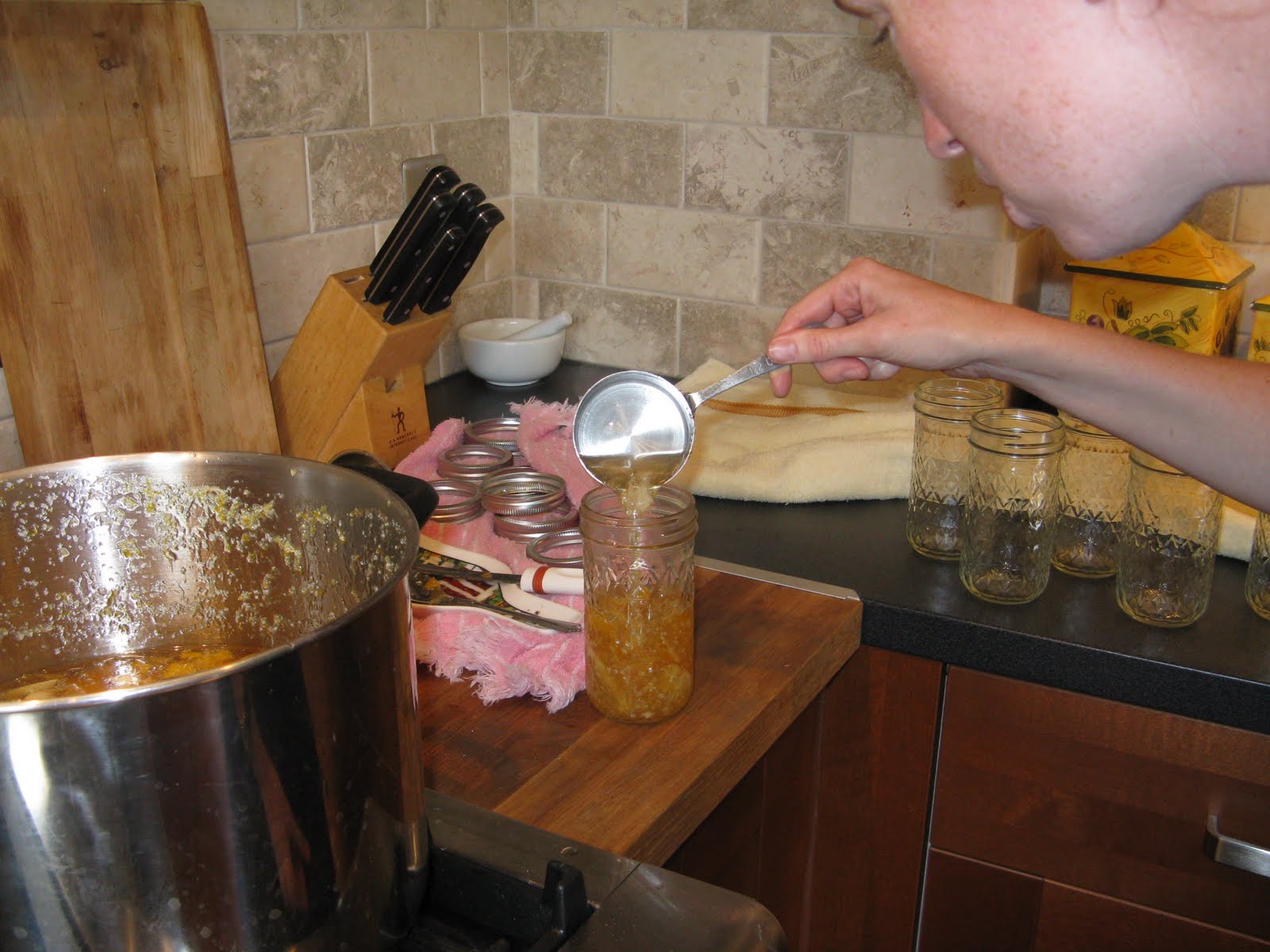
.......and within minutes, all seven jars had sealed, thus safely preserving our pickles and the rhubarb for the 8 weeks or so required before being suitable to sample. As we finished, Jane looked at me somewhat quizzically, asking what exactly we would be using this pickled rhubarb for. The recipe noted that they made a "lovely addition to any buffet table," which sounded nice but not very likely. But I did some brief searches around other preserving sources, and found many pickled rhubarb recipes or ideas, from served alongside poultry and as a glaze for meats, as an excellent accompaniment to grilled asparagus (definitely need to try that one out), as a tasty salad ingredient, and a boon to any cheese, dried meat or pate plate. In fact, that very night at local fave The Linkery, we were excited to find a tiny dish of candied rhubarb accompanying our Point Reyes Blue Cheese board (alongside white peaches and house made spent-grain sourdough crostini). Ideas, ideas, ideas.


..................................................................................................................................................


So, as the summer slowly glides on, bringing with it more sunshine and ever-warmer evenings, no doubt our fruit trees and garden will continue offering up handfuls or basketfuls of fresh produce each week, forcing us to stay on our toes and always leaving time in the day for an emergency canning operation. It's endlessly satisfying, it's a lot fun, and they will make excellent presents as the seasons change.

Thursday, July 8, 2010

Two Ways To Destroy Your Career (One, Actually)

It's been a rough summer for Arab-American journalists. Female Arab-American journalists, actually. For seemingly no sooner had the dust settled around the Helen Thomas foofaraw that word came from CNN that twenty-year veteran Octavia Nasr was being relieved of her duties after tweeting some thoughts on the passing of a notable Shiite cleric. In either case, vengeance was swift. Too swift, I would put forth.

What's that you say? Didn't know Helen Thomas was Arab-American? While she was born in Kentucky, both parents hailed from Syria (Tripoli, to be exact, now part of Lebanon) and the family name was anglicized at Ellis Island from Antonious to Thomas. While Thomas has never drawn exceeding amounts of attention to this fact (actually distancing herself from any attempt at hyphenating her ethnicity), she has spoken frankly of incidents during school in which she came home in tears after being taunted as a "foreigner" and a "garlic-eater". I'm willing to respect Thomas' desire to avoid applying needless focus on her ethnicity, so why not simply examine her accomplishments? That would be covering all presidential administrations between Eisenhower and Obama; being named the first female officer of the National Press Club; the first female member and eventual president of the White House Correspondents' Association; and the first female member of the Gridiron Club.

Thomas perhaps became best known through her combination of sheer longevity in the journalism business, and her rather overt decision to embrace a more controversial and accusatory line of questioning in the spring of 2000. This decision, she has since made clear, had everything to do with her abrupt resignation from United Press International (UPI) and her move to Hearst Newspapers. Her UPI resignation came after an announcement that the news organization was about to be purchased by News World Communications, the side project and property of Unification Church leader and celebrity-courting fraud Rev. Sun Myung Moon. Freed from the constraints of UPI reportage, Thomas let her feelings fly. These feelings notably found a wide target in the George W. Bush administration, and while I suspect Thomas wouldn't have wasted her time much playing favorites with either political party, there was a sense of mutual contempt between questioner and questioned.

That is, when Thomas was actually getting called on. From the start, Thomas' insistence that Israel be held to the same exacting standards applied by the United States to other countries did not sit well with the administration or, indeed, much of the Washington press corps or Georgetown elite. Ari Fleischer notably claimed Thomas held "strong views on the Middle East" - as if every other Washington insider has only vaguely heard of the place and couldn't commit to offering an opinion for the public record. And while an autograph-seeker and moonlighting sports columnist for The Daily Breeze managed to get Thomas uttering some disdainful commentary about George W. Bush ("worst president in American history") and Dick Cheney ("a liar") which he quickly published, Thomas did apologize to the president and rarely let her emotions get the better of her. Having said this, I'm sure she was a royal pain in the ass for Ari Fleischer and other Bush press corps minions. Her bias only added to her mystique.

All this is lots of fun for wonks and Washington observers, but I would note a darker edge to the typical back-and-forths between reporters and know-nothing press handlers. On July 18, 2006, Thomas sharply questioned now-deceased Press Secretary Tony Snow on the ongoing Lebanon War, then at its peak and eventually to lay claim to the deaths of 1,500 Lebanese civilians and the displacement of one million Lebanese and 500,000 Israelis. In her questioning, Thomas noted that the United States could have applied greater pressure on Israel in an effort to slow or ease the bombardment of Lebanon. "Thank you for the Hezbollah view," Snow quickly responded. Consider this glib remark for a moment - a seasoned reporter of Arab heritage asking about appropriate levels of diplomatic pressure being applied in order to ease civilian deaths is accused of being a mouthpiece for a Shi'a Islamist paramilitary organization identified by the United States as a terrorist organization. Even during the darkest years of the Bush administration, contempt for the press rarely reached such lows.

Clearly, Helen Thomas had some issues with the current actions of the State of Israel. In this she is hardly alone, although her position of power as a noted journalist did distinguish her. However, to accuse her of anti-Semitism or even anti-Israel rhetoric on the basis of such remarks seems rather dubious, reeking of the same mentality that paints anybody questioning the need to go to war as a traitor (while, oddly enough, often elevates tax evaders to the status of genuine patriots). Even the most reactionary media watchdog group couldn't hope to turn a few tough questions into grounds for dismissal. They would have to bide their time, and hope that in the age of Twitter and 24-hour news, the smoking gun would surface eventually.

And surface it did, in the unlikely form of a shaky video taken by Rabbi David Nesenoff outside a White House-sponsored Jewish Heritage Celebration Day, in which Thomas was asked for her thoughts on Israel. What followed is a dismaying, somewhat-incoherent, and utter p.r. disaster of a rant - ill-conceived, juvenile, risible. "Tell them to get the hell out of Palestine," she opined, and after being urged on by Nesenoff, she added Israeli Jews should "go home" to "Poland," "Germany," "America" and "everywhere else". She was quickly rushed away into a waiting vehicle while a supposedly astonished Nesenoff posted the footage to his website the following week. I have no reason to suspect Nesenoff of being disingenuous when he claims to have had no inkling of Thomas' views on Israel before approaching her with video camera in hand, but given his own activities as a blogger and "bias consultant" (his term, not mine), dispatched to counsel Mel Gibson after the washed-up actor's drunken anti-Semitic rant made the headlines, I find it hard to believe he didn't suspect he might uncover something juicy when he stopped Thomas on her way from the White House event. The speed with which Nesenoff made the rounds of talk shows and newspapers also suggested at least some amount of media savvy, as he referred to her comments as a "vile paradigm of hate talk" and claimed she "thought the Jews should leave Israel and return to the final solution".....which isn't really all that accurate, but certainly makes for a memorable soundbite.

I'm inclined to agree with Rabbi Nesenoff that telling Jews to go back to Germany represents a rarefied height of insensitivity and historical ignorance, and that any supposedly rational human being who would spew forth such nonsense is worthy of our contempt, if not our attention. I suppose one could make the case over the course of a two-hour symposium or a thirty page research article that there is a supreme irony in one of the most persecuted and suffering cultures in world history contributing to the suffering of others through widescale displacement and the creation of refugees. One might put forth a discussion examining the future of Zionism and how it might manifest itself outside the state of Israel, and indeed how countries such as Germany and Poland could have their Jewish communities restored. It's a discussion requiring prolonged discourse, enormous reserves of compassion and an awareness of the weight of history. It is not something to spit into a video camera in a sixty-second exchange.

So while I can't label the fall of Helen Thomas a witch hunt, I do believe there were many people on the sidelines eager to see her go and willing to fan the flames. Her ridiculous comments may forever overshadow her other accomplishments, and as the White House Correspondents' Association washes their hands of her as an "indefensible," I hear that the Society of Professional Journalists is thinking of renaming their "Helen Thomas Award for Lifetime Achievement" for somebody less worthy of contempt.

....................................................................................................................................................................

I hadn't planned on writing about Thomas' ignoble departure at this or any other length, with a few conversations on the matter with friends and family serving as enough exploration of the matter. But when I read the news of Octavia Nasr being canned, things started getting interesting again. The Senior editor of Middle Eastern Affairs at CNN was abruptly fired yesterday after tweeting that she "respected" recently deceased Shiite cleric Grand Ayatollah Mohammed Hussein Fadlallah. The three-day fallout leading to her termination was mercifully brief, but long enough for me to think, "There goes another Arab-American journalist." A Lebanese immigrant, Nasr was born in Beirut, worked twenty years at CNN, and was a recipient of the Edward R. Murrow Award, among others. While my CNN-watching days are long behind me, she always seemed the rare informed individual among the morass of cable news petulance. I suspect that in a desperate attempt to remain relevant in our changing information landscape, various CNN anchors and commentators were urged to spread the word via Facebook and Twitter, get their hands dirty with a little cutting-edge social media, tweet and post and don't ever let 'em forget you're out there. Anchors acquiesced. Nobody paid attention until one of them screwed up.

Yet how, exactly, did Nasr screw up? I'm far from an expert on Mohammad Hussein Fadlallah, and much of his track record seems dismayingly familiar to anybody even dimly aware of Hezbollah and Middle Eastern politics - Holocaust deniers are practically par for the course. But we should be willing to agree that Nasr was not praising Fadlallah's views on these or other matters, but on Fadlallah's rather remarkable liberal views on the role of women within Islamic society. These were notable indeed - fatwahs issued against honor killings and female circumcision, and calls for the right of women to defend themselves against any act of violence, be it physical or social violence. Additionally, Fadlallah insisted that women were the equal of men and that female individuals should be seen as role models for both men and women. Such talking points may seem rather quaint in our supposedly enlightened society (or so we like to tell ourselves), but coming from a notable marja', a figure only below that of the Quran, the Prophets and the Imams in regards to authority on religious law, they were somewhat astonishing.

This is clearly the aspect of Fadlallah that Ms. Nasr was referring to when she composed and transmitted the following tweet on July 4th; "Sad to hear of the passing of Sayyed Mohammad Hussein Fadlallah.. One of Hezbollah's giants I respect a lot..." Within hours, several media watchdog groups had seized upon the tweet as evidence of colossal bias and stupendous anti-Semitism on the part of Ms. Nasr (you'll forgive me if I suggest that these watchdog groups may have been some of the few followers of Nasr's Twitter account?) and unsurprisingly, Nasr quickly offered up an apology by way of the now-cliched "error of judgement" statement. The following day, she was canned by CNN. "We believe that her credibility in her position as senior editor for Middle Eastern affairs has been compromised going forward," claimed the network's senior vice president for newsgathering in the typically mind-numbing language currently masquerading as our mother tongue.

Can anybody offer up anything positive coming from such a hasty overreaction to a fairly innocuous tweet? Aren't all tweets fairly innocuous by design? If Helen Thomas' comments were shocking in their unfiltered vehemence, Nasr's seem barely shrug-worthy. How much depth can one plumb, especially regarding an individual life, in the Twitter-mandated format of 140 characters (140 words would barely be enough)? If being audacious enough to express any hint of respect or even non-loathing for a recently deceased individual, in any capacity or for any reason, can easily be seen as offering support for the annihilation of Israel, our culture has succeeded in gagging any possibility of holding adult conversations on any matter involving the Middle East.

Lest anyone doubt my personal beliefs or good politics, let me be unusually frank here and toss ambiguity out the window (sorry, Prof. Dintenfass!). I'll support any effort to combat the scourge and obscenity that is anti-Semitism, from rooting it out of the mainstream media or from under the rock where the lowest blogs fester. The closest I've ever come in my adult life to getting in a fist fight was when a co-worker disdainfully referred to a dishonest customer as "acting Jewish" in my presence. I'll cast any available stones at those who would claim willful ignorance of history or would attempt to paint the original motivations behind Zionism and the founding of the State of Israel as anything other than a necessary action for ethnic and cultural survival. I consider Holocaust deniers, doubters or dismissers to be lower than vomit. But please don't insult my intelligence by parsing every other verb for possible inappropriateness or yanking comments so far out of context they get slammed with decompression sickness. Bias can move in more than one direction, you know.

..................................................................................................................................................................

A final thought, tangentially related. The great novelist, activist, Nobel Laureate and Holocaust survivor Eli Wiesel is not a figure I'd dare accuse of insensitivity. Yet he has courted some degree of controversy recently by taking out full page ads in various mainstream American newspapers. This extended letter/essay spoke at length of his belief that the city of Jerusalem lacks any true Muslim connection, and he urged the current White House administration not to apply "pressure" to Israel regarding giving up settlement expansion in the city. Jerusalem, he says, "is mentioned more than six hundred times in Scripture—and not a single time in the Koran". He adds, "For me, the Jew that I am, Jerusalem is above politics".

One understands where Wiesel is coming from. But I wonder if Wiesel had chosen to tweet a comment as absurd, contentious and simplistic as "Jerusalem is above politics" - to make such a claim about a city created in its modern state through politics of the most extraordinary degree - if any watchdog groups might have pounced on the matter? I'm aware of an open letter, signed by over one hundred Jews currently dwelling in Jerusalem, who have attacked Wiesel on this and other various other points in his ad. The full text can be read on their website, Just Jerusalem / Sheikh Jarrah, in which they lay out exactly why they feel bitter when American citizens hold Jerusalem up as an emblem or a symbol while leaving the actual facts of living in the city to others. It's a worthy response - mannered, measured, suitably outraged, informed, concerned. And I hadn't heard a word about the entire affair until the New York Review of Books re-published the open letter in late May. Neither Helen Thomas nor Octavia Nasr could be mistaken for Eli Wiesel. But I'd like to think Nasr deserved something like an open letter of rebuke rather than the three-day media frenzy she got.

LATE EDIT, 07/09/2010: and it keeps going.

Saturday, July 3, 2010

Homophobia Is Alive and Well and Spewing From the Maw of Gallagher


[image created by yours truly via photo-manipulation of video upload]

Anybody with cable access to Comedy Central (or The Comedy Channel) in the early 1990s couldn't help but stumble across seemingly endless performance footage of the comedian Gallagher, looped and streaming forth during any and all hours of the day or night. You know the guy I'm talking about, even if you're lucky enough to blank at the name recognition - the sort-of-Frank-Zappa-looking-dude with an act primarily revolving around the smashing of inanimate objects via wooden mallet (dubbed the "Sledge-O-Matic"), most notably watermelons. It was easy to forget that audiences, their front rows often draped in protective plastic covering, sat through over an hour's worth of Gallagher's more mundane observational stand-up brand of comedy before the spectacular dénouement of messy smash and bash. And while it may have been the watermelon-destruction that solidified Gallagher's reputation as a fail-safe entertainer of the 1980s and 1990s, I always noted that almost 90 percent of his act consisted of somewhat sluggish, non-daring verbal comedy of the snarky and "ever-notice" school (although noticeably clean, as continually pointed out by many vocal fans over the years).

As a teenager, I must admit to initially enjoying the physical aspect of Gallagher's comedy, getting a kick out of the splatter of fruit and milk containers. Who wouldn't at that age? The rest of his act seemed pretty pedestrian, and I often found myself drifting towards thoughts of, say, Richard Lewis. Eventually, Gallagher's spots started to appear less and less on the expanding Comedy Central network, and soon this mustachioed figure receded (in my mind, at least) to the level of late-80s nostalgia, nudged somewhere in levels of cultural importance between Crocodile Dundee and Alf. When I came across a capsule review by Rob Patterson from an early- 80s reference source - "so-called comedian...his jokes are the product of a truly banal mentality, and Gallagher's delivery is that of a precious twit" - I at first found the sentiments a bit harsh, then quickly nodded in agreement. For years afterward, whenever my mind strayed to thoughts of Gallagher (which was not very often, dear readers), my mind immediately assented "so-called comedian".

End of story, or so I thought. For it seems that Gallagher has recently "re-invented" himself as a comedian delivering a decidedly un-banal brand of humor that, while still "clean" (whatever that means), has veered sharply into the realm of extreme right-wing politics (fine with me) and pure, untrammeled queer-bashing (not so fine with me).

Lindy West of Seattle's weekly alternative newspaper The Stranger recently penned an article recounting Gallagher's performance at the Admiral Theater, and it reads like a piece of immersion journalism - an undercover look and infiltration of a radical conglomeration or a vaguely millenarian society. Except that no infiltration was necessary - West simply attended a sold-out show in a Seattle suburb by a moderately established "comedy legend". And while attendees could still count on getting drenched with detritus from the Sledge-O-Matic, ticket buyers could also be greeted with sneering lines like this one, hurled at a young man in the front row: "You have your hat on backward. Are you a homosexual? Because it seems you have a problem figuring out the front from the back".

West's piece deserves to be read in its entirety - here's the link. Because this is not simply an example of a few off-color remarks tossed aside to make sure the audience is paying attention or to shore up some "comedy is dangerous" bona fides. Gallagher's entire act now seems to revolve around endless rancor directed towards the gay community. West seems equally distressed at the nasty right-wing politics also present during the performance, such as Gallagher's pronouncement that Obama "ain't black. You're a latte. You're half whole-milk. It could be goat milk—you could be a terrorist!" Or his complaint regarding Guantanamo Bay, running along the lines of, "We weren't even allowed to torture all the way. We had to half-torture—that's nothin' compared to what Saddam and his two sons OOFAY and GOOFAY did". Dumb as this stuff is, I can't work up too much outrage or bile over our political differences - political comedy is, by definition, only amusing to the flattered parties. But the unrelenting homophobia, utterly devoid of nuance or wit - "Without God, we are nothing but dust. What is butt dust? Is that what you get if your homosexual isn't properly lubricated?" - becomes almost numbing.

In the end, even Gallagher's grand finale of family-friendly destruction can't help but include a few nauseating nods towards no-holds-barred bigotry. Pouring first an oversized jar of Chinese vegetables and then another of fruit cocktail into a tin pan, he hoists his hammer and announces, "This is the China people and queers!!!" before drenching the front row.

West doesn't recount any incident of audience walkouts during the Bremerton performance, which doesn't mean there weren't any - just that they weren't numerous. Maybe Gallagher's audience knows exactly what they're in for these days, and it sounds like plenty are lapping it up. But if Michael Richards' ill-fated meltdown at the Laugh Factory can become a cultural meme, then Gallagher's celebration of unapologetic gay hatred deserves similar notoriety. While he remains as unfunny as he was back in his late 80s "heyday," I guess at least Gallagher can finally refute the banality charge once levelled against him by Rob Patterson. Only what was that Hannah Arendt said about the banality of evil?

Friday, July 2, 2010

Christgau's Consumer Guide: July 1969 - July 2010


During my sophomore year in college, perusing the bookshelves somewhere on the third floor of the Seeley G. Mudd Library as I so often did in those days, I stumbled across a fat, red hardcover book bearing the moderately authoritarian title Christgau's Record Guide. Inside, I found 470 pages of dense script featuring capsule reviews of 1970s albums/records/recordings, followed by letter grades. Being a sucker for rock criticism at the time, I checked it out and began toting it with me to the cafeteria, campus benches, and local restaurants. I quickly discovered this volume was far more than just another collection of slapdash record reviews or some type of supplement to the likes of The Rolling Stone Album Guide (in either its Dave Marsh or Anthony De Curtis manifestation). Even a hurried glance at any page confirmed my initial suspicion that this Christgau character wasn't interested in offering biographical details or even placing the individual artist into easily-digestible frameworks. He expected you to show up with a functioning level of appreciation and awareness, he wouldn't dare insult your intelligence, and he expected you to do some close reading. In this respect, he resembled favorite writers and critics from my current studies in the English Literature department more than any "mere" music critic. In fact, it was Christgau who alerted me to the possibilities available to any gifted writer - that subject matter counts less than compositional ability.

It was only later that I realized this record guide was no mere one-off but a collection of monthly "Consumer Guide" columns that ran in The Village Voice and, to a lesser extent, Newsday and Creem throughout the 1970s. What's more, he had never stopped - I discovered a 1980s Record Guide at the Menasha Public Library that summer and came across electronic editions of the current Village Voice running new monthly columns throughout 1998 and 1999. This was no small discovery, because it offered a second revelation of sorts - the possibility of cultural critics remaining engaged with mass and popular culture long after the individual writers had ceased playing any sort of immediate role within a so-called youth culture. By 1998, Christgau was clearly on the wrong side of twenty, or thirty, or forty (I wasn't sure exactly). But he was writing about contemporary music, including teen pop and hip-hop, with an enthusiasm and (this is key) an awareness that transcended age. It's startling now to look back at myself at age twenty-one and see how easily I might have become locked into an ossified critical credo that rejected certain basic strands of musical creativity while foolishly elevating minor variations on niche genre experimentation at the expense of others. I've since met otherwise intelligent individuals whose musical tastes run unfailingly across strictly demarcated lines of "good' and "bad," in which the "bad" often encompasses huge swaths of black pop or contemporary rap, or the "good" barely acknowledges anything not 1981-1988 era hardcore. While it may sound hyperbolic, the cultivation of an encyclopedic musical knowledge has become something like a moral necessity in my mind.

But all that's neither here nor there. My appreciation of Christgau ultimately stems from the fact that his writing caught my fancy and continued to hold my interest as I matured and journeyed forth from the Midwest to the Northeast and the West Coast. Even more importantly, his reviews helped introduce me to a wide variety of music, both old and new, that might otherwise have never come my way. When Christgau's tastes during the mid-1980s took a decisive shift to include the world of Afropop, I'm sure he confused and even alienated many followers who couldn't see the connection between American-based r&b and, say, the Bhundu Boys. I recall skipping over many of those reviews myself as I raced to find opinions on Gang of Four or The Replacements. But when my own interests started wavering in the direction of the melodic, insistently rhythmic, and gently propulsive offerings that is Afropop's gift to the world (sometime in my late twenties, and especially so in my early thirties), it was Christgau's treasure trove of insight on the matter that helped fill my shelves with the likes of King Sunny Ade and Luambo Franco.

So it came as bittersweet news yesterday that Christgau was pulling the plug on the Consumer Guide once and for all, after 41 years of near-continuous monthly appearances. Much of the work has been collected in individual volumes dedicated to decades, but perhaps a better way to experience the full breadth of his accomplishment is to visit his website, which features, among many other things, complete Consumer Guide columns in chronological order going back to the very first, in the July 10th edition of the Village Voice. Taken together, these Consumer Guide reviews offer as studied and as rewarding an investigation into popular culture as any one critic could muster. As I've written before in this space, they deserve to one day be collected within the pages of The Library of America. At the very least, his Consumer Guide mini-reviews should enjoy healthy circulation among electronic-based enthusiasts who may well marvel at the possibilities available once upon a time to a school of writing and criticism - dense, erudite, refined yet profane, scholastic, unapologetically political, witty, acerbic, fearless and often quite kind - that has little place in our increasingly post-literate cultural landscape.

Anyway. In brief recognition of forty-one years of work, may I offer an attempt at a tribute? The opening pages of Christgau's Consumer Guide: Albums of the 90s includes this dedication:

This book is dedicated to everyone who's ever written to thank me for turning him or her on to a record. If I haven't responded, I'm sorry. It always means a lot - in fact, it helps keep me going.

Now might be as good a time as any to thank him for fifteen recordings that might otherwise have never entered heavy-rotation in our house.

Gogol Bordello - Super Taranta!
Buck 65 - Talkin' Honky Blues
Old 97s - Fight Songs
DJ Yoda - Fabriclive.39
Randy Newman - 12 Songs
Orchestra Baobab - Pirate's Choice
Brakes - The Beatific Visions
The Go-Betweens - Before Hollywood (or all of them, really)
Orlando Cachaito Lopez - Cachaito
Steinski - What Does It All Mean?
Mountain Goats - Tallahassee
Sonny Sharrock - Guitar
Mekons - OOOH! (out of our heads)
Franco & Rochereau - Omana Wapi

Tuesday, June 29, 2010

We Are The Village Green(s) Preservation Society

Part One: To Dry

It was almost exactly one year ago to the day that Jane and I set about transforming our kitchen into a vast pickling operation, slicing ripe and ready cukes and embalming them with a wicked vinegar/salt/dill/pepper/clove brew (details shared here). Twelve months on, we're still enjoying them and have several jars still safely brining.

Continuing this stroll into the past, one of my recent posts concerned my desire to allow food items to drift into their natural state of rot - a manifesto of sorts on the virtue of decay and one kind of sustainability. So, why not continue this train of thought and examine two additional methods used in coaxing green materials to extend their life and general usefulness - namely, the art of drying and the art of preserving.

Now comfortably settled into our new place of residence a few miles inland, our front and back yards have begun offering up the bounty promised us by our landlord when we first eyed the place in early winter 2009. Any number of fruit trees have started producing rapidly ripening produce, their branches nearly sagging due to the weight. We aren't the only ones noticing the upcoming harvest, though. Neighborhood squirrels have moved their chattering battalions into enemy territory, and one particularly beautiful-yet-not-quite-ripe peach has gone down in masticated defeat. It was time to bring on the offensive and declare fruit-picking season.

However, one can only consume so many nectarines in one sitting, as my wife well knows from several memorable and uncomfortable childhood encounters. Likewise, perfectly ripened fruit, once off the branch, tends to move too rapidly into that realm of rot I've been loudly praising. So there we were, with a bushel or a peck of nectarines quickly inching past their prime.

The answer, we agreed, lay in dehydration, or, more poetically, food drying. Lacking appropriate equipment, Jane looked about various San Diego merchants before concluding that food drying ranked astonishingly low on the list of Things To Do In San Diego Before You Die. Tanning booths, tattoo parlors, real estate opportunities, dog walking operations - they proliferate in this tacky, migratory land. But a simple contraption for drying sliced fruit, picked herbs or fresh fish? Take that back-to-the-land crap, well, back to the land.

While we by no means exhausted the local opportunities for food dehydrators (I'm guessing Escondido's Country Store had one), it was left up to the good folks of the Walla Walla Valley in eastern Washington to plug this particular gap. Passing through during my road trip to points north, my mother-in-law calmly pointed me in the direction of food dehydrators at a local Bi-Mart, assuring me they were as common and as easy to find as chapstick and AA batteries in this agricultural region bisected by Mormon and Seventh Day Adventist communities. It was packed into the back seat and bumped along 395 towards home.


It was a remarkably simple operation. The nectarines were sliced as the dehydrator was assembled....


....and individual slices were placed in concentric rings along the plastic rack.


Soon, one level was filled.....


...so we moved on to another.....


....before turning the heat up and covering with the lid.


And how's this for being detail-oriented? The cast-offs and non-sliced nectarine chunks were gathered up and placed inside a food processor to be whizzed into a thick fruit paste....

....and poured into an additional rack to create a small piece of fruit leather (fleather?).


The little guy chugged along, surprisingly quiet, throughout the night. Next morning, I dismantled the racks and found a nice haul of dried nectarines.


Take that, squirrels.
...............................................................................................................................................
Part Two: To Preserve
The flip side to drying, one might argue, is pickling and/or preserving. We've been down this road before, too, but armed with a newly-purchased book by Pam Corbin called The River Cottage Preserves Handbook inspired us to venture beyond the ways of grape jelly (the fact that we left our concord grape vines behind us in Ocean Beach might be another reason). Corbin's recipes are distinctly British, and while certain recipes may be a little out of our reach (hedgerow jelly, for example), the English mastery of preserves and pickles was inspiring. Having never tried our hand at marmalade, the several variations outlined in the book led me to eye our small yet astonishingly productive lemon tree just outside the kitchen door. As an added bonus, citrus fruits come ready-packed with natural pectin, so we wouldn't need to thicken the batch with any store-bought packets. And with plenty of sugar in the pantry and just enough honey to complete the recipe, we could create 7 jars of marmalade without spending a dime.
So, I made the arduous trek to the lemon tree (limoncello tree, to be exact)....


...and weighed 2 1/4 pounds exactly.


We chose the "whole fruit approach" for our marmalade, merely slicing off the little top nubbins and giving the lemons a good scrub before placing them whole inside a boiling pot of water for nearly two hours, until the fruit was soft enough to be easily punctured by fork tines.


This might be the time to bore you with a brief history / semantics lesson. "Marmalade" is a specific English term for any food preservation efforts utilizing citrus. Other fruits are labeled jams (fruit pulp) or jellies (thickened juice only), which is why we speak of, say, strawberry jam but grapefruit marmalade. The iconic British jar of orange marmalade, made from bitter Seville oranges, is actually a Scottish invention dubbed "Dundee Marmalade," hailing from the northeast coast of Scotland in the late eighteenth century. Prior to this time, "marmalade" referred to a type of quince-based candy. In 1770, so the story goes, a man named James Keiller bought a large amount of oranges being sold at surprisingly cheap prices, thinking to make an easy profit through his own business. What he discovered was that the oranges had been sold cheaply due to their remarkable bitterness, which left them nearly inedible. It was Keiller's wife who suggested turning the bitter oranges into a quince-like marmalade, which the Keiller Company stills does to this day, with many variations on the original. Which means we owe our morning dollop of bittersweet orange marmalade to Mrs. Keillor's belief that one should "waste neither oranges nor money".
If seville oranges are bitter, so are lemons, which is why the recipe works rather interchangeably, save for the addition of honey at the expense of two of the ten cups of sugar required.


The lemons were removed and allowed to cool before being sliced and removing the seeds. Sugar and honey was added and the concoction was brought to the requisite rolling boil.


After ten minutes or so, we began testing to see if our brew had reached the setting point - the period in which the sugars, fruit and pectin have begun to coalesce into a thicker substance once the sample has cooled. This can be somewhat tricky to determine.

However, we were soon satisfied by the setting point, and began to ladle the fruit into sterilized canning jars.....


...and carefully prepping them for no-holds-barred preservation.


After a quick bath in boiling water, the jars were removed to cool on a towel, and we soon heard that sound beloved by all home preservers - the thwuck of the jars sealing themselves. It never gets old.

We had a little left over that didn't make it into the jars, so we've been sampling that over the past few days, spreading it inside crepes, dolloping it on top of Greek yogurt, or simply eating it, British-style, from the spoon. Seven jars, good for two years. The art of preservation lives on.
..............................................................................................................................................................
Bonus: footage of the moment of thwuck.

Saturday, June 19, 2010

The Bookish Pacific NorthWest

San Diego might just be the worst major city in these United States for book lovers. I haven't visited San Antonio, Houston or Dallas, so perhaps Texas might trump my glittering city on the Pacific (and I suspect Phoenix is probably even worse, but since I don't actually consider Phoenix to be a major city, I've left them out of the equation), but I'm just going to whine in my chains and be frank. Warwick's up in La Jolla is a decent store, with an especially nice selection of Taschen releases and pricey coffee table books, but it's far from being especially notable (plenty of towns with populations under 50,000 in the Midwest boast similar stores). Hillcrest has two used bookstores across the same street from each other that are noteworthy, although BlueStocking Books is the only one I really frequent. And aside from a few others scattered across our sprawling urban core, I think that's pretty much it. I'm not including Borders or Barnes and Noble, temples to kitsch and overpriced bran muffins. Perhaps it's due to a four month stint I did at an Albany, NY Borders store, but I like to think of that place as where book lovers go to have a good cry.

There's always Amazon, of course, but I'm the type of guy addicted to the art of the browse, where one accidentally stumbles across some item or two (or five) that one didn't even know existed but that suddenly deserves a place on the bookshelf. Browsing is a dangerous art, especially for those like me who refuse any effort at labelling, pigeonholing or specialization. Marxist thought? 1970s T-shirt design? Food dehydrating? Serbian literature? Hell, yes.

So, when my road travels take me north of the Bay Area, I always set aside some car space and bank account funds for stocking up on the great world of literature supported by the good folks of Northern California, Oregon and Washington, the non-sun people who recognize a good cup of joe, a solid pint of beer and a world-class non-chain bookstore when they see one. I missed San Francisco this time around (sorry, City Lights!) to make a stop in Sacramento, but from Corvallis, OR on, it was bookworm time. At the risk of simply compiling a shopping list from my week in the NW, I thought I'd make a quick inventory and celebrate three fantastic businesses helping to keep literacy alive and functioning in the drizzly parts of this great land.

Left Bank Books, Seattle

Mere steps from Pike Place Market, this slightly cramped, two-story anarchist bookstore carries items ranging from classic fiction to small-run political theory screeds printed on thrice-recycled wood pulp. I make a beeline for it whenever I'm in the area. Excellent choices abound along their new releases/arrivals shelf, but the entire store is a blast for browsing. I twice ducked inside during this recent visit, and helped liberate the following items....

Los Angeles; The Architecture of Four Ecologies, by Reyner Banham (epochal 1971 study of the built environment of L.A., including explorations of the four distinct "ecologies" of the region - beach, freeways, flatlands and foothills)

Climate Refugees, by Collectif Argos (examines nine population centers in which global climate change is disturbing and will disturb local livelihoods)

The Literary Conference, by Cesar Aira (tiny pocketbook fiction from Argentinian author, examining a translator fallen on hard times seeking global domination through a clone of Mexican author Carlos Fuentes. I'm not quite sure I get it either)

The Coming Insurrection, by The Invisible Committee (notorious textual statement from French ultra-left group, eventually seized as evidence in terrorism trial. Pen mightier than the sword and all that)

Mama, Is It Summer Yet? by Nikki McClure (over sized children's book featuring cut-paper illustrations helping to explain growing seasons and counsel patience for blooms)


Elliott Bay Book Company, Seattle

Having pulled up stakes from its old location in Pioneer Square, I finally tracked down the new Elliot Bay Book Company high above in Capitol Hill, and although the walk was rather far from my hotel, I admit the new location seems better suited for the business, nestled in among coffee shops, hip record stores, and the constant foot traffic from the nearby community college. While parts of the store remain under construction, it retains the same multi-level, pleasantly-wooded layout that has made it such a favorite. After such a long walk, I decided to go to town.

The Book of Fathers, by Miklos Vamos (most accomplished novel of this contemporary Hungarian writer, chronicling 300 years and 12 generations of his fellow countrymen)

Desert America; Territory of Paradox, by Actar Press (photo-heavy exploration of "the alternate American desert" of a supposedly empty territory turned over to visions of excess (Las Vegas), the sublime (Grand Canyon) and technological apex (weapons research) - a heady fever dream of our most least understood landscape)

Wall and Piece, by Banksy ("portfolio" of sorts of one of our greatest living artists, who just happens to work in the realm of graffiti and public walls, and who lists the amount of time each artwork lasts before being dismantled or painted over by the authorities. Tremendous stuff)

Bookhunter, by Shiga (graphic novel detailing the adventures of a book detective/bounty hunter employed by the Oakland Public Library. All librarians deserve a copy)

Hocus Bogus, by Romain Gary writing as Emile Ajar (new translation of playful meta-fictional work by a late French master working under a pseudonym)

Ten Walks / Two Talks, by Jon Cotner and Andy Fitch (tiny poem book that re-imagines the journals of Japanese poet Basho as two men exploring the landscape of 21st century Manhattan)

The Collected Stories of Lydia Davis (compact yet hefty collection of contemporary short story master Davis, who often requires little more than a few sentences to construct her tales)

Skylark, by Dezso Kosztolanyi (obscure 1920s novel from the former Austro-Hungarian empire, detailing how the parents of "unintelligent, unimaginative, unattractive and unmarried" daughter Skylark discover themselves when she leaves for a one week vacation)

The Book of Ebenezer La Page, by G.B. Edwards (only published novel by British civil servant, released posthumously, examining the memories of a man willingly exiled to the Isle of Guernsey, thereby becoming neither a part of Britain or France but something in between)

The Giant Jam Sandwich, by John Vernon Lord and Janet Burroway (wonderful 1970s children book I recall well from Neenah Public Library days, in which an infestation of mosquitoes leads a small village to create a sticky trap of jam and bread)

Slow Loris, by Alexis Deacon (uproarious children's book of a zoo-dwelling slow loris (primitive member of the primate family) who bores visitors with sloth-like activity but achieves astonishing heights of activity come nightfall)


Powell's City of Books, Portland

Last, certainly not least, P-Town's monument to all things bound and printed, visited twice during our less-than-twenty-four-hour stay in America's most European city. On my second visit, determined to merely browse, I left my wallet safe in the hotel room - a fail safe plan.

Poem Strip, Dino Buzzati (groundbreaking 1960s graphic novel from uncategorizable Italian avant-grade artist and writer, a visionary tour of a make-believe street in Milan)

The One-Straw Revolution, by Masanobu Fukuoka (1970s Japanese rejection of modernized agribusiness from a farmer/intellectual credited as an early spokesperson for the alternative food movement)

Nox, by Anne Carson (book-object poem-thingy, made from an original art work created after the death of Carson's brother - photos, cuttings, scraps, dissections of Catullus' Poem No. 101, all in folding-out accordion paper)

Bonsai, by Alejandro Zambra (Chilean novella, of love occurring between two people, one of whom vanishes, the other of whom pretends to edit a book that doesn't exist. Latin American lit - the wave of the future)

Another Science Fiction; Advertising the Space Race 1957-1962, by Megan Prelinger (glorious visual tour through American ad design pushing the limits of science and presenting the farthest reaches of space and the unknown as just another zone ready for Yankee can-do optimism and real estate ventures)

Roadside America; Architectural Relics from a Vanishing Past, by John Margolies (typically lovely Taschen art book featuring the photographs from the vast Margolies collection, of the over sized kitsch and architectural quirks sprinkled along the nation's many byways. Some I've even seen myself)

The River Cottage Preserves Handbook; The Dehydrator Cookbook; Complete Book of Small-Batch Preserving; The Fruit Expert; Fruit Trees/Fresh Berries (self-explanatory, and much-needed)

....................................................................................................................................

Careful readers may have noticed the presence of several children's books scattered throughout my selections of Latin American fiction and political theory. While this has absolutely nothing to do with my recent coursework in Youth Services and Programming (far from it), it does have everything to do with an upcoming event I'm only recently beginning to announce and that will hopefully arrive sometime in the middle of December 2010. It may be somewhat early to start collecting children's books so many months out, but I'd like to be ready. If you think I'll be relying on television programs to sharpen young minds and teach vocabulary, you've been reading the wrong blog. Onward we go.